When we hear the term digital addiction, images of rehabilitation programmes, excessive gaming, or teenagers struggling to disconnect from their devices often come to mind. Public attention tends to focus on intervention after problematic behaviour has already emerged. However, public health research has consistently highlighted the value of prevention as a strategy for reducing the likelihood and severity of behavioural and health-related problems before they become entrenched (Durlak & Wells, 1997). This principle is increasingly relevant in discussions of problematic digital use among young people. The Erasmus+-supported DigRight project adopts this preventive perspective by seeking to strengthen young people’s awareness, digital competencies and self-regulation skills before harmful patterns of technology use develop.
Prevention as a Public Health Strategy
In public health literature, prevention is commonly described at three levels: primary, secondary and tertiary prevention (Marlatt & Donovan, 2005). Primary prevention aims to reduce risk factors and strengthen protective factors before a problem emerges. Secondary prevention focuses on the early identification of risk and timely intervention, while tertiary prevention seeks to reduce the negative consequences of an established problem and minimise relapse.
In the context of problematic digital use, many interventions occur only after excessive screen time, academic decline or psychosocial difficulties become visible. Research from prevention science suggests that investing in early-stage preventive efforts can contribute to positive developmental and well-being outcomes among young people (Botvin & Griffin, 2004).
Can Digital Addiction Be Prevented?
The available literature provides cautious optimism. In a systematic review of internet addiction prevention studies, Vondráčková and Gabrhelík (2016) noted that the field remains relatively underdeveloped but identified several promising approaches, particularly within educational settings.
Several prevention programmes described in the literature combine information provision with broader skill-development components. Rather than focusing solely on awareness raising, these interventions often seek to strengthen self-regulation, coping strategies, decision-making abilities and critical thinking skills.
This distinction is important because knowledge alone rarely produces sustained behavioural change. Young people are more likely to make healthy choices when they possess the personal and social skills necessary to manage digital environments effectively.
Skills, Awareness and Alternative Behaviours at the Core of Prevention
One of the most important goals of prevention is fostering young people’s confidence and competence in navigating online environments. Livingstone and Helsper (2010) found that adolescents with stronger internet skills and higher levels of online self-efficacy were generally better positioned to benefit from online opportunities while managing associated risks more effectively. Their findings suggest that preventive strategies should prioritise empowerment rather than reliance on restriction alone.
From this perspective, the objective is not to disconnect young people from digital technologies but to help them engage with them in a conscious, balanced and responsible manner. Digital literacy and digital citizenship education therefore become central preventive tools.
The European Commission’s DigComp framework emphasises that digital competence extends beyond technical ability to include critical evaluation, responsible participation and the protection of personal well-being in digital environments (Carretero, Vuorikari, & Punie, 2017). Helping young people understand how digital platforms are designed to attract and retain attention may strengthen their ability to make more deliberate and informed choices online. In this sense, awareness can function as a protective factor against automatic and excessive patterns of use.
How Does the DigRight App Support Prevention?
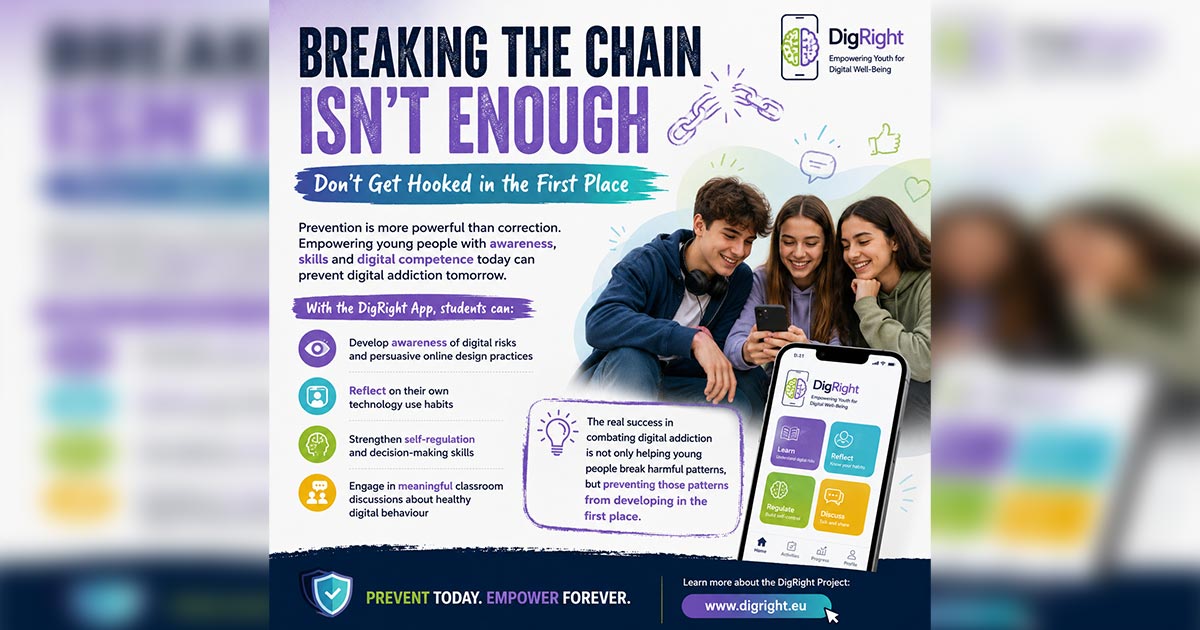
The DigRight mobile application serves as a practical educational tool through which preventive principles can be translated into everyday learning experiences. Its design allows teachers and students to engage with prevention at multiple levels.
Primary Prevention
Students who do not currently display problematic patterns of technology use can learn about digital risks, persuasive design features and healthy online habits through interactive scenarios. By increasing awareness before significant problems emerge, the application seeks to strengthen protective factors and digital resilience.
Secondary Prevention
Students who may be showing early signs of excessive screen use can use self-reflection and self-assessment activities to recognise emerging risks. Early recognition can create opportunities for timely behavioural adjustments before more serious difficulties develop.
Thirdial Prevention
For students already experiencing problematic digital use, DigRight is not intended to replace professional support. However, when used alongside teacher guidance and school counselling services, it can provide a structured framework for reflection, behaviour monitoring and relapse-prevention strategies.
This multi-layered approach positions DigRight not merely as a mobile application but as a broader educational resource that supports prevention within the school ecosystem.
Restrict or Empower?
A recurring debate in discussions of digital well-being concerns the balance between restriction and empowerment. Policies that limit smartphone use in schools may contribute to classroom management and reduce distractions during school hours. However, researchers increasingly argue that sustainable digital well-being also requires the development of self-regulation skills that extend beyond the school environment.
Consequently, many scholars recommend combining reasonable boundaries with digital literacy education, parental mediation and opportunities for healthy offline activities (Kuss & Griffiths, 2017). DigRight is designed around this balanced philosophy. Rather than portraying technology as inherently harmful or promoting unrestricted use, it encourages informed and responsible engagement with digital tools.
School Climate and Peer Influence: The Social Dimension of Prevention
The effectiveness of prevention is often influenced by the broader social environment in which young people learn and interact. Interventions aimed solely at individual students may have limited impact if the surrounding culture remains unchanged. By contrast, when entire classrooms engage in discussions about digital habits, online risks and responsible technology use, healthier behaviours can gradually become part of the social norm.
The DigRight application supports this process by providing teachers with structured content that facilitates classroom dialogue and collaborative reflection. Prevention therefore moves beyond the individual level and becomes embedded within the educational environment itself. Prevention science has long recognised peer influence and social learning as important factors in shaping young people’s behaviours (Botvin & Griffin, 2004).
Conclusion: Prevention Before Intervention
Societal responses to problematic digital use often remain reactive rather than preventive. Concern tends to increase only after difficulties become visible. Evidence from prevention research suggests that early, skill-based and educational approaches may help reduce risk and strengthen young people’s capacity to navigate digital environments responsibly (Durlak & Wells, 1997; Vondráčková & Gabrhelík, 2016).
The DigRight project seeks to bring these preventive principles into classrooms through an innovative educational application that promotes digital awareness, self-regulation and informed decision-making. While no single intervention can eliminate all risks associated with digital technologies, prevention offers an opportunity to address challenges before they escalate into significant problems. In the field of digital well-being, success is not only about helping young people break harmful patterns—it is also about equipping them with the skills needed to avoid developing those patterns in the first place.
References
Botvin, G. J., & Griffin, K. W. (2004). Life skills training: Empirical findings and future directions. Journal of Primary Prevention, 25(2), 211–232. https://doi.org/10.1023/B:JOPP.0000042391.58573.5b
Carretero, S., Vuorikari, R., & Punie, Y. (2017). DigComp 2.1: The digital competence framework for citizens with eight proficiency levels and examples of use (EUR 28558 EN). Publications Office of the European Union.
DigRight Project. (n.d.). DigRight. https://digright.eu/
Durlak, J. A., & Wells, A. M. (1997). Primary prevention mental health programs for children and adolescents: A meta-analytic review. American Journal of Community Psychology, 25(2), 115–152. https://doi.org/10.1023/A:1024654026646
Kuss, D. J., & Griffiths, M. D. (2017). Social networking sites and addiction: Ten lessons learned. International Journal of Environmental Research and Public Health, 14(3), 311. https://doi.org/10.3390/ijerph14030311
Livingstone, S., & Helsper, E. J. (2010). Balancing opportunities and risks in teenagers’ use of the internet: The role of online skills and internet self-efficacy. New Media & Society, 12(2), 309–329. https://doi.org/10.1177/1461444809342697
Marlatt, G. A., & Donovan, D. M. (Eds.). (2005). Relapse prevention: Maintenance strategies in the treatment of addictive behaviors (2nd ed.). Guilford Press.
Vondráčková, P., & Gabrhelík, R. (2016). Prevention of internet addiction: A systematic review. Journal of Behavioral Addictions, 5(4), 568–579. https://doi.org/10.1556/2006.5.2016.085